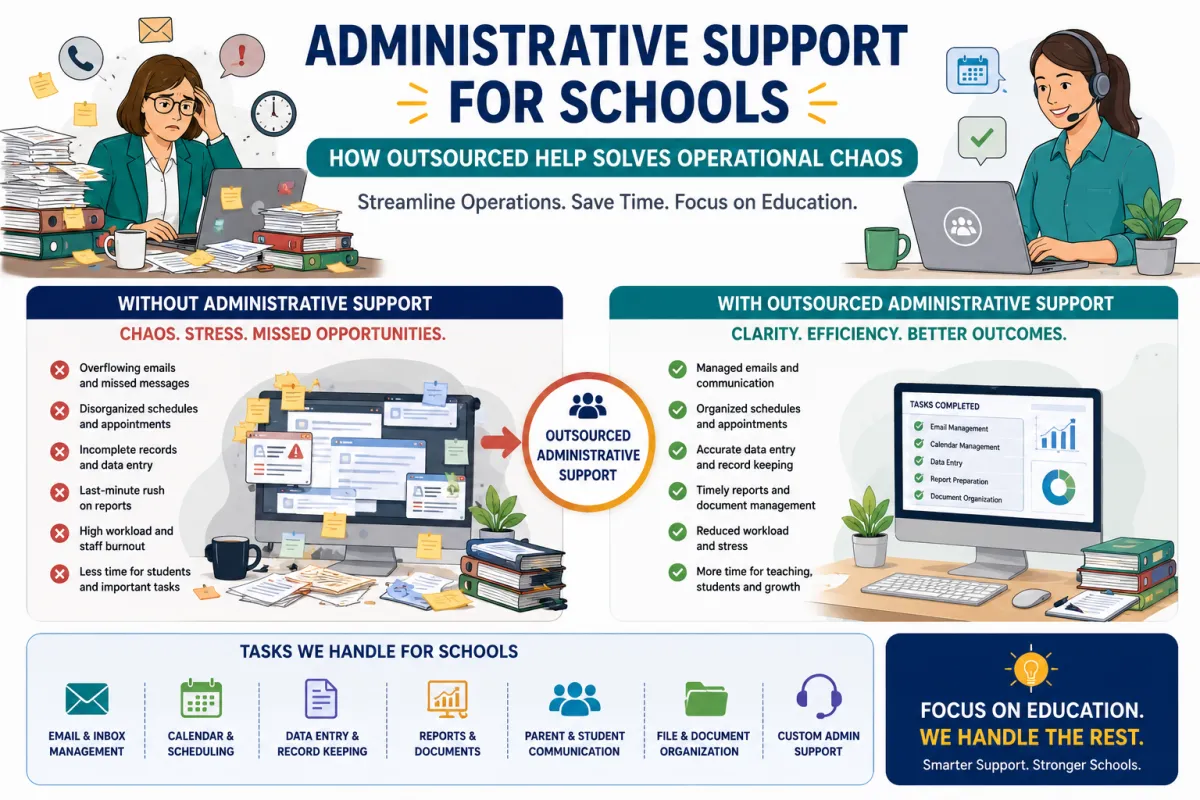
Administrative Support for Schools: How Outsourced Help Solves Operational Chaos
Walk into any small private school, charter school, or independent learning center on a Monday morning, and you will see the same scene. The principal is taking phone calls about substitute teachers. The office manager is hunting down a missing transcript. A parent is waiting at the front desk to discuss a tuition issue. The IT person is troubleshooting the printer. None of this is education. All of it is taking the staff away from education.
Administrative support for schools is not glamorous, but it is the foundation that lets teaching happen. The schools that consistently deliver strong academic outcomes are not always the ones with the best curriculum. Often, they are the ones whose teachers and leaders are not drowning in operational work.
This guide walks through what administrative support actually looks like for K-12 schools in 2026, which functions to keep in-house, which to outsource, and how to build the operational backbone that lets your educators focus on teaching.
Why Schools Need Different Administrative Support Than Childcare or Business
School operations have unique characteristics that generic admin services do not understand:
Strict student records compliance under FERPA and state laws
Complex enrollment cycles tied to academic calendars, not rolling year-round
Multi-stakeholder communication across teachers, students, parents, and sometimes school boards or districts
Substitute teacher coordination on tight timelines
Standardized testing logistics and reporting
IEP (Individualized Education Program) and 504 plan documentation for students with special needs
State reporting requirements that vary widely by jurisdiction
Donor and fundraising coordination for private and nonprofit schools
A generic virtual assistant can do general admin work. A school-aware administrative support partner understands the rhythm of academic calendars, the legal requirements around student data, and the specific pressure points that derail school operations.
8 Administrative Functions Every School Should Streamline
1. Parent and Family Communication
Schools field hundreds of parent communications per week. Tuition questions, attendance issues, schedule changes, behavior reports, event RSVPs. Centralized communication systems and dedicated admin support cut response time and free teachers from email overload.
Dedicated school email inbox with shared access
Triage protocols so urgent issues escalate to leadership
Templates for the 20 most common parent questions
Automated reminders for events, deadlines, and required documentation
2. Enrollment and Admissions
School enrollment cycles are intense and seasonal. Application reviews, interview scheduling, financial aid processing, and re-enrollment all hit at predictable times. Strong admin support handles the workflow without burning out your admissions team.
Many of the same principles that apply to childcare enrollment apply to schools, with longer timelines and more documentation. See our guide on how to market a childcare center for parallel marketing tactics that translate to school admissions.
3. Student Records Management
Transcripts, attendance, immunizations, IEPs, behavior records, transcripts for transferring students. Schools sit on mountains of paperwork that must be accurate, accessible, and compliant with FERPA.
Digitize all student files in a secure system
Maintain consistent naming conventions and folder structures
Track which records need updates each year
Process transcript requests within 48 hours
Ensure all required documentation is on file before students start each year
4. Substitute Teacher Coordination
Substitute coverage is one of the highest-frequency, highest-stress admin tasks at any school. When a teacher calls in sick at 6am, someone has to find coverage by 8am or chaos follows.
Maintain an active list of qualified substitutes
Use automated systems (or VA-supported calls) to fill openings fast
Keep substitute folders ready with lesson plans and class lists
Track substitute hours for payroll and budget purposes
Build relationships with reliable subs who will pick up at short notice
5. Compliance and State Reporting
Schools face significant reporting requirements that vary by state but typically include attendance reports, demographic data, testing results, financial reports, and accreditation documentation. Missing deadlines can result in fines, lost funding, or accreditation issues.
Create a master compliance calendar for the year
Assign clear ownership for each report
Document the process for recurring reports so they can be handed off
Audit compliance documentation quarterly, not just at deadlines
6. HR, Hiring, and Staff Management
Teacher recruitment, background checks, certification tracking, and ongoing HR support can all be supported by administrative partners. See our guide on how to hire preschool teachers for principles that translate to K-12 hiring, particularly around screening, references, and onboarding.
7. Bookkeeping, Tuition Collection, and Financial Reporting
Schools have complex finances. Tuition collection, financial aid disbursement, fundraising tracking, vendor management, and board reporting all need clean books. See our guide on bookkeeping for childcare centers for the core principles, most of which apply to schools with added complexity around academic year reporting cycles.
8. Technology and Software Support
Schools rely on student information systems (SIS), learning management systems (LMS), parent communication platforms, financial software, and a dozen other tools. Coordinating all of these and supporting staff who use them is often outsourced to IT partners or admin support teams with technical capability.
Signs Your School Needs Administrative Support Now
Most schools wait too long before bringing in administrative support. Here are the early warning signs:
Teachers regularly complete admin tasks after hours or on weekends
Your office staff is in constant reactive mode, never proactive
You miss state reporting deadlines or get late notices
Parent complaints about communication are increasing
Substitute coverage is a daily fire drill
Tuition collection is consistently behind schedule
Student records take longer than 48 hours to produce when requested
Leadership spends more time on operations than on education or strategy
If three or more of these are true at your school, the cost of NOT having proper administrative support is already higher than the cost of getting it.
In-House vs Outsourced Administrative Support for Schools
Most schools use some combination of both. Here is how to think about which is which:
Keep in-house:
Front desk and visitor management
Direct student supervision and safety roles
In-person family interactions and admissions tours
Crisis response and emergency coordination
Confidential personnel matters
Senior leadership and strategic decisions
Outsource or supplement with virtual support:
Bookkeeping and tuition collection follow-up
Compliance reporting and documentation
Email and phone triage during peak hours
Records management and digitization projects
Marketing and admissions outreach
Event planning and coordination
Substitute coordination and HR paperwork
Website updates and technology administration
For more on the framework of what to outsource and what to keep in-house, see our guide on outsourcing for childcare centers, most of which applies to schools as well.
The Real ROI of Administrative Support for Schools
School leaders sometimes resist administrative support because it feels like overhead. The math usually argues otherwise.
Consider a small private school with 200 students:
A principal who spends 15 hours per week on operational tasks at an effective rate of $60 per hour is consuming $45,000 per year of leadership time that could be spent on teaching, fundraising, or strategy.
Teachers spending 5 hours per week on admin work across a team of 15 represents $75,000 per year of teacher time pulled away from instruction.
Late state reporting penalties, lost tuition due to slow collections, and reduced enrollment due to communication problems can easily add another $30,000 to $80,000 in hidden costs.
A $30,000 to $60,000 annual investment in proper administrative support pays for itself many times over, both financially and in the quality of education delivered.
5 Mistakes Schools Make with Administrative Support
1. Hiring generalists instead of school-specialized support
A general office manager can answer phones, but they will struggle with FERPA, state reporting nuances, and the rhythm of academic operations. School-aware partners deliver value from day one.
2. Underinvesting in systems before outsourcing
If your processes live in someone's head, no outside partner can effectively take them over. Document workflows, organize digital files, and standardize procedures before bringing in support.
3. Treating support staff as separate from the educational mission
The best administrative teams understand they are enabling education, not just shuffling paper. Bring them into your culture, share your goals, and recognize their contribution to student outcomes.
4. Failing to plan for the academic calendar
Schools have predictable busy periods. August before school starts, January re-enrollment, May graduation. Plan administrative staffing and outsourcing around these peaks, not just average needs.
5. Skipping compliance training for support staff
Anyone handling student information needs to understand FERPA at minimum. Schools that skip this training risk privacy violations that can result in lawsuits, lost funding, or accreditation issues.
Frequently Asked Questions About Administrative Support for Schools
Is administrative support for schools FERPA compliant?
It can be, with the right partners and practices. Any vendor handling student information must sign a FERPA-compliant agreement, follow data security best practices, and limit access to only what is necessary for their work. Reputable school-focused administrative partners take this seriously and have documented compliance practices.
Can a small private school afford administrative support?
Yes. The myth that admin support is only for large schools comes from old models where you hired full-time staff. Modern virtual and outsourced services let even small schools (under 200 students) access specialized support for $1,500 to $5,000 per month, often replacing $40,000+ in unfilled in-house positions.
How long does it take to onboard administrative support at a school?
Most schools see meaningful improvements within 60 to 90 days. The first 30 days are heavy onboarding, training, and documentation review. By day 60, the support team is handling assigned tasks independently. By day 90, you should see measurable improvements in response times, compliance, and staff capacity.
What's the difference between a school administrator and an outsourced admin partner?
A school administrator is your in-house leader who manages day-to-day operations, makes decisions, and represents the school in person. An outsourced admin partner extends that administrator's capacity by handling specialized tasks, documentation, communication, and routine work remotely. The two complement each other, they do not replace one another.
Can DW Bridges provide administrative support for K-12 schools?
Yes. DW Bridges provides administrative support services for K-12 schools, charter schools, and independent learning institutions, in addition to early childhood centers. Our team handles compliance reporting, parent communications, records management, and operational tasks tailored to each school's specific needs and academic calendar.
Ready to Let Your Educators Focus on Education?
Every hour your teachers spend on administrative work is an hour not spent teaching. Every minute your principal spends chasing paperwork is a minute not spent leading. The schools that consistently produce strong outcomes are not the ones with the biggest budgets or the fanciest facilities. They are the ones whose operational backbone is strong enough to let educators focus on what they do best.
At DW Bridges, we have spent years building administrative support systems for schools, charter networks, and independent learning institutions. From staffing and recruitment to leadership training, CRM and parent engagement tools, and full administrative support, our services are built around the realities of running a school in 2026.
We serve early childhood through K-12, single sites and multi-campus networks, public and private institutions. Whatever your school's specific challenges, we have likely seen them before and built solutions that work.
If you want a free operational assessment to see exactly where your school could benefit from administrative support, book a complimentary call today. We will review your current operations, identify the highest-leverage opportunities, and build you a tailored plan.
Your educators chose this work to change lives. Let's give them the time to do it.
