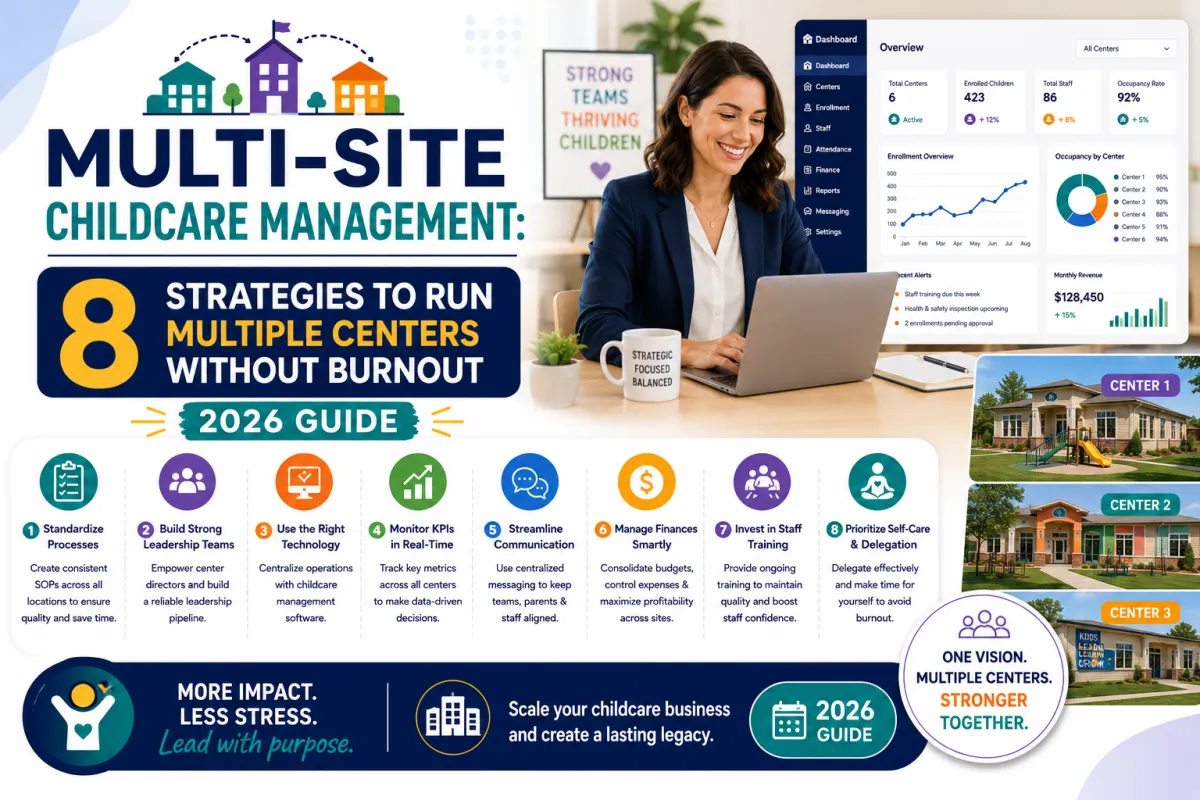
Multi-Site Childcare Management: 8 Strategies to Run Multiple Centers Without Burnout
Running one childcare center is hard. Running two, three, or five is a different sport entirely. The skills that built your first location (showing up every day, knowing every family, fixing every problem yourself) actively work against you when you scale. The owners who grow successfully are the ones who stop being the operator and start being the architect.
Most multi-site owners learn this the hard way. They open location two thinking it will double their income, only to find their first center starts slipping the moment they take their eyes off it. By location three, they are working 70 hour weeks across multiple buildings and wondering why expanding felt like a mistake.
It does not have to go that way. Multi-site childcare management is a real discipline with real principles. This guide walks through the eight strategies that separate the centers that scale successfully from the ones that hit a wall at two locations.
Why Multi-Site Management Is Fundamentally Different
Single-site owners run a business. Multi-site owners run a system that runs businesses. The shift in mindset is the hardest part of growth.
Specifically, multi-site owners face challenges that single-site owners never do:
You cannot be in every classroom every day. Quality has to be designed into your systems, not enforced by your presence.
Staff at site B do not know you the way site A does. Your culture has to travel.
Financial visibility gets messy fast. You need consolidated reporting and per-site profit and loss statements.
Brand consistency matters more. Families talk. If site A and site B feel like different schools, your reputation suffers.
Hiring and training become 2x or 5x the volume, with the same number of hours in your day.
Compliance gets harder. Each site has its own licensing, inspections, and local quirks.
The strategies below address these head-on.
1. Build a Strong Director at Every Site Before Opening
The single biggest mistake in multi-site childcare is opening a new location without a director who can run it. You become the de facto director by default, which means you are now splitting your attention between two centers and doing the job of both.
Before opening any new site:
Identify and groom an internal candidate at least 6 months in advance
If hiring externally, recruit and train them 90 days before opening
Pay competitively. A strong director at $65,000 to $85,000 is the cheapest insurance you can buy
Make sure they have run a classroom and supervised staff before, not just one or the other
Give them autonomy over hiring, scheduling, and day-to-day decisions
If you cannot find a director you trust to run the new site, do not open the new site yet.
2. Standardize Operations Across All Locations
Every site you operate should run on the same playbook. Different sites with different processes create chaos at scale.
What to standardize:
Daily classroom schedules and routines
Drop-off and pick-up procedures
Parent communication templates and tone
Incident response protocols (injuries, behavior issues, parent complaints)
Hiring process and onboarding checklist
Performance review cycles and templates
Tuition collection and late payment policies
Health and safety procedures
Build an operations manual. Update it quarterly. Every new staff member at every site reads the same one. This is how brands like KinderCare and Bright Horizons feel consistent across hundreds of sites.
3. Use One Software System Across All Sites
If site A is on Brightwheel and site B uses paper sign-in sheets, you cannot manage them as one business. You cannot compare numbers. You cannot spot trends. You cannot enforce consistency.
Pick one CRM and operations platform, roll it out across every location, and require its use. Look for tools that offer multi-site dashboards and per-site reporting in one login. See our guide to the best CRM for childcare centers for what to look for.
Centralizing software typically saves multi-site operators 10 to 20 hours per week in administrative overhead.
4. Build Centralized Back-Office Functions
By the time you have two or three locations, you should not be doing bookkeeping, payroll, marketing, or HR at each individual site. These functions should live at the corporate level, serving all locations.
Functions to centralize once you cross two sites:
Bookkeeping and accounting
Payroll and benefits administration
Marketing and enrollment lead management
HR, hiring, and compliance
Vendor and supply purchasing
IT and software administration
Centralization saves money through economies of scale and frees your directors to focus on operations and people, not paperwork.
5. Establish a Weekly Operating Rhythm
Multi-site owners who try to manage by walking around will fail. You need a structured operating rhythm that gives you visibility without consuming your week.
A typical weekly rhythm for a multi-site owner:
Monday: 30-minute call with each director. Review last week, plan this week.
Wednesday: 60-minute leadership team meeting with all directors together.
Friday: Review key metrics across all sites. Enrollment, staffing, finances, parent satisfaction.
Monthly: Site visit to each location. Walk classrooms, observe, eat with the team.
Quarterly: Full leadership offsite. Strategy, planning, team building.
This is how you stay informed without being everywhere. When directors know the rhythm, they prepare for it. Problems surface earlier, decisions get made faster.
6. Track Per-Site Metrics Religiously
You cannot improve what you do not measure. Multi-site owners need a dashboard that shows them how each location is performing against the others and against itself over time.
Key metrics to track per site:
Enrollment count and capacity utilization
Revenue and profit (per site, not just consolidated)
Staff turnover and average tenure
Parent satisfaction scores (NPS or similar)
Tour-to-enrollment conversion rate
Incident reports and parent complaints
Compliance status (licensing, training certifications, food program if applicable)
Review these weekly. Compare sites against each other. A high-performing site teaches the others what works. A struggling site signals where to intervene before it becomes a crisis.
7. Create Cross-Site Career Paths for Your Best People
One of the unexpected advantages of multi-site operations is that you can offer real career paths to your staff. A lead teacher at site A who wants to grow can move to assistant director at site B, then director at site C.
This produces several wins:
Retention. Strong staff stay because they see a future
Internal promotion. You build your own talent pipeline instead of hiring directors from outside
Cultural transfer. Promoted staff carry your culture with them to new locations
Lower hiring costs. Internal promotion is cheaper and lower-risk than external recruitment
Make these career paths explicit. Publish them. Talk about them at every quarterly leadership meeting. Your team should know exactly what it takes to grow at your company.
8. Resist the Urge to Open the Next Site Too Soon
This is the most counterintuitive piece of advice in this guide. Most owners want to scale fast. The ones who succeed long-term scale carefully.
Before opening another site, all of these should be true:
Your existing sites are profitable and stable
You have a director ready (or already hired) for the new site
Your back office can absorb the additional volume without breaking
You have cash reserves to cover 6 months of operating expenses for the new site
You have a clear marketing plan to fill enrollment in the new location
Your current parent satisfaction scores are strong (you are not running from a problem)
Opening a new site to escape problems at your existing ones rarely works. Fix what is broken first.
Frequently Asked Questions About Multi-Site Childcare Management
How many staff do I need for a multi-site childcare operation?
Beyond classroom ratios required by your state, multi-site owners typically need a director per site, an assistant director per site for centers over 60 children, plus centralized roles. At two sites you usually add one centralized administrator. At four or more sites you need a regional director, dedicated bookkeeper, and marketing person at minimum.
When should I open a second childcare location?
Most consultants suggest waiting until your first location has been at 90 percent capacity for at least 12 months, is generating consistent profit, and has built a leadership bench that can run it without you. Opening earlier is possible but significantly higher risk.
How do I keep quality consistent across multiple childcare sites?
Through systems, not presence. Standardized operations manuals, common software, regular leadership meetings, per-site metrics, and centralized hiring and training are the levers that maintain quality. Site visits matter, but the visits work because the systems work, not the other way around.
What software is best for multi-site childcare operators?
Look for platforms with multi-site dashboards, consolidated billing, cross-site reporting, and the ability to assign staff and admins to specific locations. Procare, Brightwheel, and Sandbox all handle multi-site. The right pick depends on your size and which features matter most. DW Bridges helps multi-site operators select and implement the right platform for their specific needs.
How do I prevent burnout running multiple childcare centers?
Burnout in multi-site operations almost always traces back to one thing: the owner trying to do operational work that should be delegated. Strong directors, centralized back office, weekly operating rhythm, and clear metrics let you run multiple sites in 40 to 50 hours per week instead of 70. If you are working more than that, your systems are not yet built.
Ready to Scale Without Losing Your Mind?
Multi-site childcare management is not just doing more of what you already do. It is a different discipline that requires different systems, different leadership, and different thinking. The owners who scale successfully are the ones who invest in those systems before they need them.
At DW Bridges, we work with multi-site childcare owners across the country to build the operational backbone that lets growth happen without chaos. From centralized back office to leadership development, from enrollment marketing across multiple locations to staffing and talent acquisition, we handle the work that holds back most expanding operators.
We also help multi-site owners with bookkeeping and payroll and leadership training across all their locations, so consistency travels with growth.
If you have one site doing well and you are thinking about the next one, or if you have multiple sites and feel like you are barely holding it together, book a complimentary call today. We will show you exactly where the leaks are and how to plug them.
You built one great center. Let us help you build a great company.
